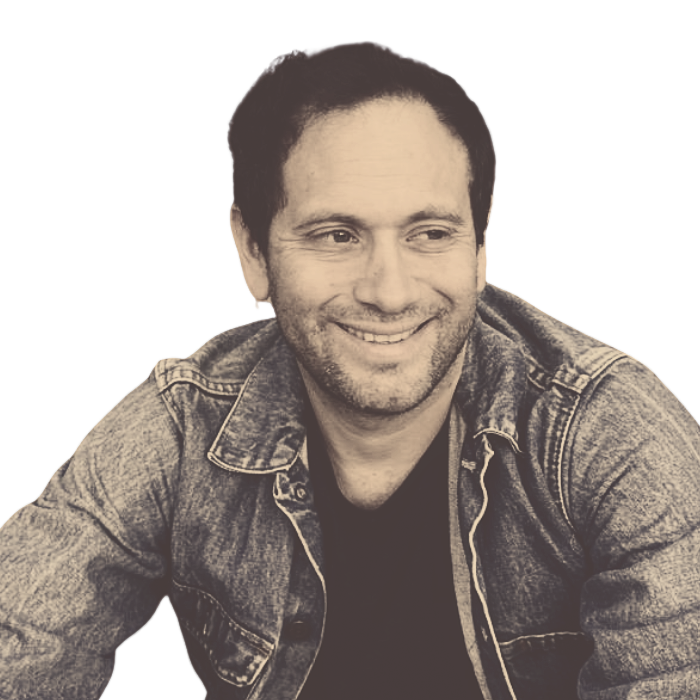
Terence Lapidus
Founder of Sideways
Terence Lapidus is the founder of Sideways, a coaching and specialist ecosystem for founders who built their business by an unconventional route. He has coached founders and leaders for 20 years. He co-founded Lucca Leadership South Africa, part of a global network that had taken more than 6,000 people through transformational leadership programmes by 2011, designed and ran a peace leadership programme for youth leaders with the Desmond Tutu Peace Centre, and has coached more than 3,500 people in one-on-one sessions. He comes from a close-knit, rather unusual family spread across Portugal, Israel, the UK and South Africa. Sideways is his fourth business.
Conventional on the outside
My grandfather left school at 16 to support his mother and sisters after his father died. He worked in a wooden box factory, then became a doctor. On the outside he was a very conventional fellow. On the inside he was a painter, a ventriloquist, a hypnotist and a chess player, and he wrote Psycho Yoga, one of the first books on yoga for the West.
He is a big inspiration for Sideways. Many of the founders I meet are like him. They got where they are by a route nobody would have drawn for them, and the people around them don't always see the whole of who they are, because they are many things and won't fit into a single box.
Twenty years of coaching
My coaching started in 2003, on a bursary to the Lucca Leadership programme in Italy. In 2006 I co-founded Lucca Leadership South Africa with Joy Olivier. Run entirely by volunteers, it was part of a global Lucca network that had taken more than 6,000 people through transformational leadership programmes by May 2011. Around the same time I designed and ran a peace leadership programme for youth leaders with the Desmond Tutu Peace Centre, and met the man himself.
Over seven years at Hatch and then Octopus Money, I coached more than 3,500 people in one-on-one sessions.
Three businesses before this one
I know the founder pressures from the inside. My first startup built South Africa's largest database of points of interest for travellers. It failed: the wrong tech, and me doing too much on my own with too little support. I knew for two years before I was brave enough to close it.
Years later, in London, I started an artisan granola brand. After two years we won a contract with Virgin Trains. It was cancelled at the last minute, along with £5m of other food contracts, when the caterer ran into trouble, and I closed the business.
My wife and I also set up and launched Silver Maiden, which sold the silver jewellery she made. I invested in it and became a shareholder.
The first taught me what it costs to do it alone. The second taught me what it feels like when one call ends it. The third taught me everything I needed to know about e-commerce and Etsy. More than that, it taught me about the pressures family businesses endure, and about boundaries. Most of all it showed me how passion can erode between co-founders.
What I see in founders now
I've spent twenty years in coaching. I've run three startups of my own, and I was the first financial coach at Hatch, which the Octopus Group bought and turned into Octopus Money. All of this put me alongside a lot of founders. I've seen their pressures, successes and failures first hand, and many times they mirrored my own.
Founders carry the weight of everyone in the business. At the end of the day they often go home to a partner, children, family and friends who aren't carrying what they're carrying, and fracture lines appear.
The pressures founders raise with me are often mentioned in passing and rarely worked on.
The founder bottleneck. Plenty of founders don't enjoy managing people. What worked at 10 people stops working at 50, and stops again at 150. Most of us hold on to control for too long and delegate badly, and the business ends up leaning on us. I did it in my first business.
Scaling without structural readiness. Growing on top of systems built for a smaller business is a huge weight.
Board and co-founder tension. It grows as new investors come in. Managing expectations, deliverables and reporting, and keeping the spark in the business, is far harder when people have different interests and outside influence.
A team that agrees, then does something else. Left alone, that misalignment grows and damages the infrastructure the business relies on.
Keeping up with AI. Founders feel pressure to move faster, be more innovative and work smarter. With the pace of AI, they're asking whether their systems and structure are right, and what to change first.
Strategic fog. Put these together and the founder can't see clearly which way to go.
Founder burnout, energy and identity. Beyond the business and their health, it reaches who they are. Passion and energy slump, the resilience they built gets strained, and then they go home to problems of another kind.
Three kinds of founder
I've been a Lumina Spark practitioner for 13 years. Lumina is built on the Big Five, the most widely researched model of personality. I've used it to look under my own skin and under founders', to see where each kind of founder gets triggered under pressure, how that plays out, and how to build the capacity to lead through it and bring more health and happiness to the people they're responsible for.
Most founders I meet fall into two groups, with a rarer third.
The first are tough, logical, competitive and purposeful, and at the same time spontaneous, imaginative and radical. They're outcome focused and think big picture.
The second are just as tough, competitive, logical and purposeful, but more practical, evidence-based and cautious. Outcome focused and down to earth. This is where we find most tech founders and co-founders.
The third are the rarest, and often the most loved. They're tough too, but prefer to work out of the spotlight. They're adaptable, flexible and spontaneous, as well as imaginative and radical. People are drawn to them, and they can burn out without anyone noticing.
Why I built Sideways
Sideways isn't a directory. Every founder gets one coach, matched to how they work, with specialists alongside for the problems in front of them now, from operations and AI to hiring, finance, energy and health.
Every founder I meet wants to work with someone who really gets them: a coach who spots their patterns, not only from training, but because they have something of the same in them. Conversation flows more easily. Laughing, sharing and being challenged come naturally when you resonate with the person you are opening up to. So the first layer of our matching is how a coach operates underneath, measured with Lumina Spark. When a founder is under pressure, a coach who works in a similar way is quicker to notice where they go. It beats reading three bios and picking the nicest photo. If the first session doesn't feel right, we rematch you once, for free.
It is also a community. Founders who got there against the grain are often lonely with it, so part of what we do is bring them together, in small groups, in person and online.
Who I build it with
Lores De Sousa is my co-founder. She is a photographer, graphic designer, music video director, vinyl record selector, and professional florist. When she started photography, more than 20 years ago, she made many believe in photography as a profession and inspired a small generation of photographers to become great artists. She has lived and worked in Portugal, Spain, Costa Rica and Uruguay. Besides being a co-founder, she is the brand's Art Director; for this role, she drew significant inspiration from historical photography archives of Japanese culture. Her father was a rally co-pilot for 3 years before becoming a successful founder. Like a rally competition with our own selves, we aimed to have a brand by December 2025 and then 30 elite coaches and specialists came on board by April. We launched Sideways in May 2026, a month late.
Outside work
I fell in love with open water swimming in Lisbon. In London I lived on seven different boats in a canal community near Little Venice. I play electric guitar and collect records. My wife Moriah is a fiction writer and a silversmith, and writes about our life on her blog, in Hebrew. My family is spread across Portugal, Israel, the UK and South Africa, so that is where you will usually find me.
David Bowie said to always go a little further into the water than you feel capable of being in. That is a fair description of how Sideways started.
Apply to Sideways
If this sounds like your kind of place, apply here. I read every application myself.